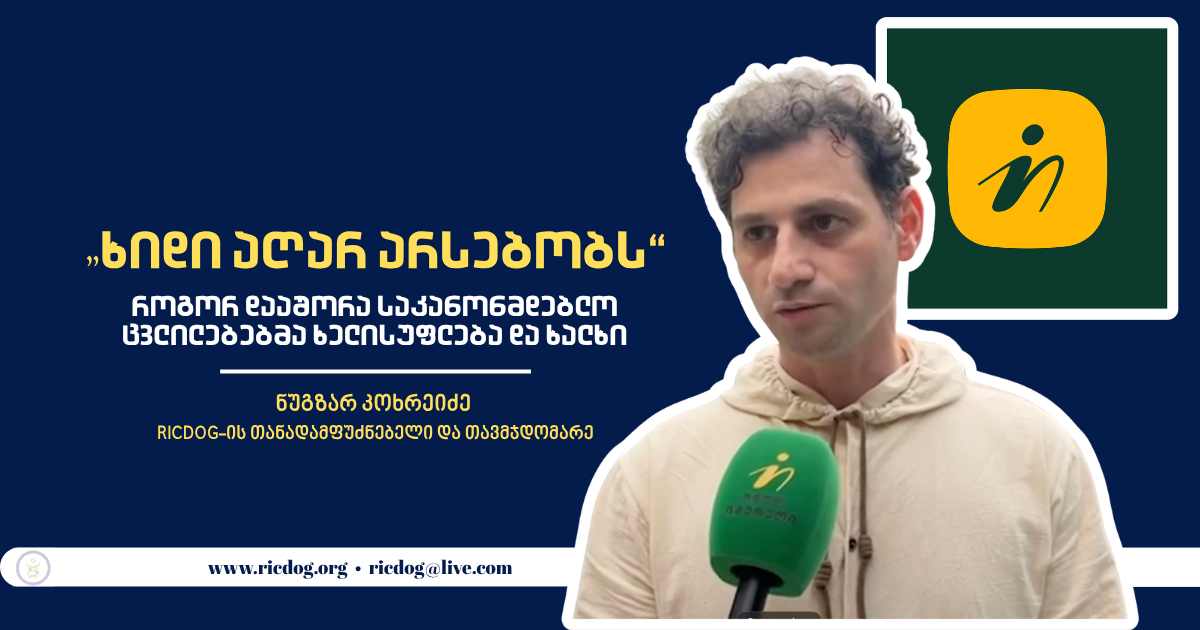
“The Bridge No Longer Exists”: How Legislative Changes Have Driven a Wedge Between the Government and the People
Recent legislative changes have profoundly affected civic life in Georgia. Speaking to Info Imereti, RICDOG Co-Founder and Chair Nugzar Kokhreidze highlighted the far-reaching consequences of restrictions imposed on civil society organizations, emphasizing that the greatest impact has been felt not by the sector alone, but by the people of Georgia, who have lost a vital bridge connecting them to the state.
The Breakdown of Accountability Mechanisms: “Citizens Have Lost Their Most Effective Tool”
According to Nugzar Kokhreidze, the most alarming consequence of these developments has been the disappearance of mechanisms for public accountability. He argues that this has directly undermined citizens’ ability to monitor and hold government institutions accountable at both the national and local levels.
“Looking at the broader picture, the first and most significant loss has been suffered by citizens themselves. They have lost their most effective tool for holding public authorities accountable—whether at the national or local level. Accountability begins with access to information: people no longer know how public budgets are prepared, what resources are allocated for the services intended to benefit them, or how they can meaningfully participate in ensuring that public budgets reflect their needs and interests…” said Nugzar Kokhreidze in the interview.
Information Vacuum and Corruption Risks
The RICDOG Chair also places particular emphasis on the loss of the expertise that civil society organizations have built over many years. Without this knowledge and experience, society is far less able to identify cases of corruption, nepotism, and the misuse of public resources, making governance less transparent and less accountable.
“…How can people know whether there is corruption or nepotism? Today, citizens no longer have access to that information because those who used to carry out independent expert analysis and investigations are no longer able to fulfill that role…” Nugzar Kokhreidze said in the interview.
Restrictions on Essential Services and the Erosion of Citizens’ Role
Beyond the loss of public oversight, Nugzar Kokhreidze also highlights the decline in the practical support that civil society organizations have traditionally provided to specific groups. According to him, weakening service-providing organizations has a direct impact on the protection of people’s rights and their access to essential services.
“…In particular, the number of organizations providing essential services has declined significantly. These organizations used to deliver specialized services to specific groups and sectors of society.”
A Broken Connection: “The Government Is Separate from the People”
In concluding the interview, Kokhreidze summarized the current situation by arguing that the country has reached a point where citizens are no longer active participants in decision-making processes. He compared this reality to the collapse of the vital bridge that once connected the government and the people.
“Third—and perhaps most importantly—today’s citizens are no longer full participants in the life of their own country. Today, the government exists on one side, while people are left on the other with their own problems. The bridge that once connected them no longer exists,” Nugzar Kokhreidze said in the interview.
Full Interview:
 English
  Georgian